From the record efficiency levels achieved with silicon-perovskite tandem technology to the growing market presence of second-generation Back Contact (BC) modules. In this interview, Gianluigi Riva, DG Sales Director at LONGi, analyses the solar giant’s industrial strategy and explains the structural advantages of BC technology in terms of energy yield, durability and power density, while looking at the evolution of the global and Italian photovoltaic markets.

LONGi has recently broken new efficiency records for tandem cells. How does this technology fit alongside Back Contact technology in the company’s industrial plans, and how realistically could the two be integrated into commercial solar module production over the next few years?
“On 14 July 2026, LONGi achieved a power conversion efficiency of 35.5% for silicon-perovskite tandem solar cells. The result was also certified by the European Solar Test Installation, an institute that is part of the European Commission’s Joint Research Centre. To date, this is the highest world record ever achieved for this technology and demonstrates LONGi’s absolute technological leadership.
“At the moment, however, despite the record, we do not have an active plan for the mass production of these tandem cells because several issues still need to be addressed. These include, for example, encapsulation and the long-term stability of perovskite. It is difficult to predict when they could actually be integrated into mass commercial production, but this is a long-term goal that LONGi aims to achieve by 2030.”
In terms of structure and performance, what distinctive advantages does BC technology, such as the HPBC 2.0 architecture, offer for light absorption and overall energy yield compared with TOPCon and heterojunction architectures?
“There are several advantages. First of all, because this technology has the contacts on the rear side, hence the name Back Contact, the surface of the cell is free of busbars. This provides 2.27% greater light absorption compared with TOPCon and heterojunction. Greater light absorption by the cell also means higher overall energy yield.
“Thanks to the glass and a pyramidal structure capable of reducing ultraviolet light reflection and increasing current, we can deliver a 2.25% increase in energy yield compared with TOPCon and heterojunction. These are precisely the characteristics that make this technology the best currently available.”
What technological solutions has LONGi introduced to ensure the stability and durability of BC modules against thermal and mechanical degradation?
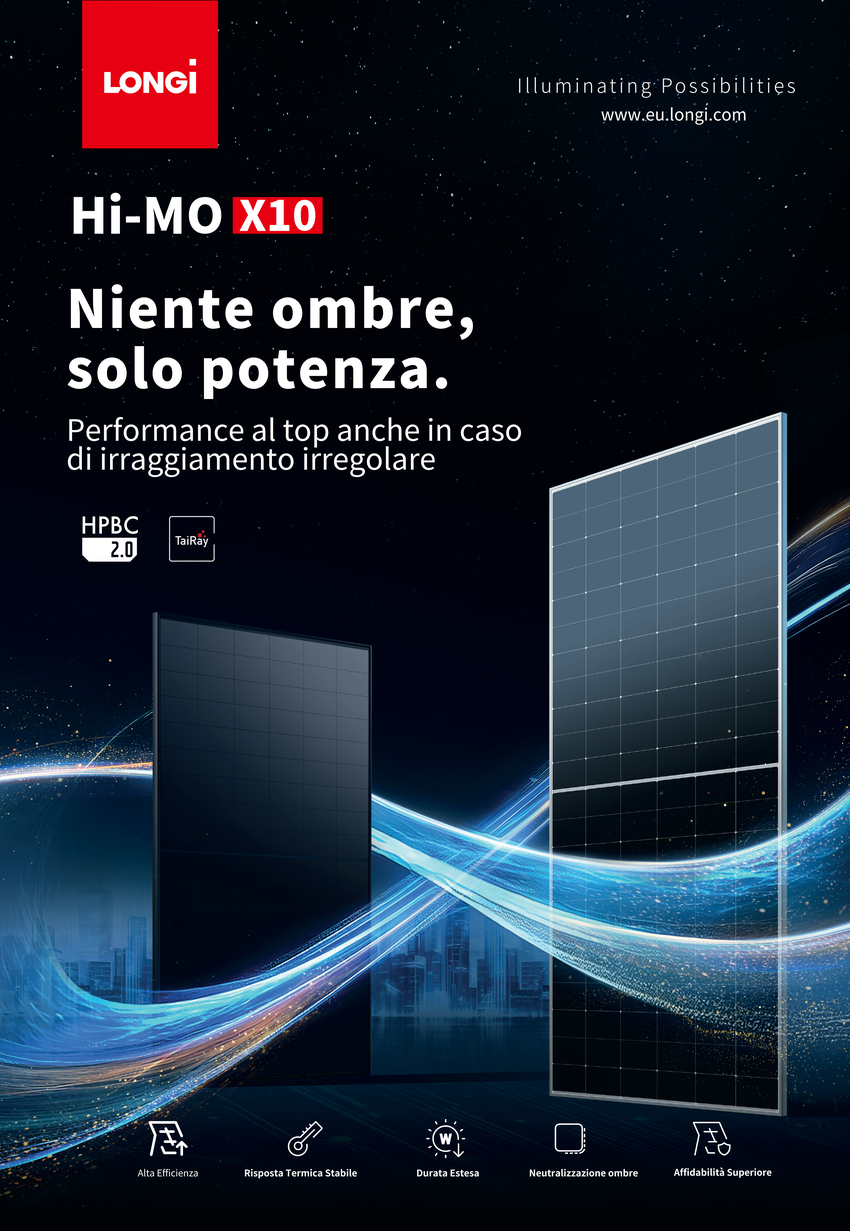
“With its new range of products based on second-generation Back Contact technology, specifically the Hi-MO X10 modules, LONGi has introduced anti-shading and anti-overheating innovations. When part of the module is shaded, it can bypass the shaded area, preventing all the connected cells from ceasing production. In this way, power loss can be reduced by up to 70% compared with TOPCon modules.
“At the same time, the anti-shading technology helps keep the module temperature under control. Thanks to a temperature coefficient of -0.26%/°C, thermal degradation of the module itself is reduced.”
“As for mechanical resistance and durability, not everyone knows that LONGi is not only a photovoltaic module manufacturer, but also a leader in wafer production. For this new generation of products, we use our TaiRay wafer, a LONGi-patented technology. It is more flexible and thicker than conventional wafers, which increases the mechanical resistance of the module itself and ensures greater long-term reliability.”
Italy had a strong residential and C&I solar segment in 2025, alongside growing momentum in large-scale ground-mounted projects. What is the current adoption rate of Back Contact modules in the Italian market, and which of these segments is seeing the fastest penetration?
“Before discussing the Italian market, we need to look at the broader picture. Today, China accounts for around 60% of the global photovoltaic market, and Back Contact modules are expected to account for around 50% of installations in China in 2026.
“In the Italian market, Back Contact modules are expected to meet around 30% of market demand in 2026. These figures give a clear indication of how quickly this technology is expanding.”
Limited land availability and grid integration challenges are key issues for European and Italian solar development. How does the higher power density of Back Contact solar technology help maximise installed capacity and overcome these physical constraints?
“The higher power density of BC technology helps maximise installed capacity because these modules deliver more power from the same surface area compared with other technologies. This means that, for the same amount of usable and available land or rooftop space, a project can achieve greater overall installed capacity.
“This is where the innovation lies, not in increasing power by making modules larger, but in increasing power while keeping module dimensions unchanged. That is a significant advantage where land and rooftop availability is limited, particularly in light of the new EN 13501-1 and EN 13501-5 fire safety regulations, which reduce the usable space.”
Looking at solar market growth forecasts for the coming years, what do you think will be the main factors shaping operators’ choices in Italy?
“Italy appears to be establishing itself as Europe’s third-largest market for photovoltaic growth, after Germany and Spain. Among the main factors that could further drive market growth, I would certainly highlight not only the adoption of higher-performing photovoltaic modules, such as our latest-generation Back Contact modules, but also the use of battery storage systems.
“These are the factors that will enable the solar market to grow, become even more structured and ensure a perfect balance of the electricity grid.”
This article was realized in collaboration with Rinnovabili.
PUBLICATION
15/09/2026
Other related news

04/09/2026
Agrivoltaic suitable areas in Italy, a fast-evolving regulatory framework

05/02/2025

15/07/2025

03/02/2025

10/07/2023

21/02/2025

13/06/2025
Solar photovoltaic capacity worldwide surpasses 2.2 TW in 2024

04/09/2026
Photovoltaics module technology accelerates beyond 25% efficiency

15/10/2025
26/08/2025
The contribution of renewables to the climate fight
29/10/2025
European PPA Market: challenges and opportunities
20/10/2023
10/07/2025
17/12/2025
Jobs in the energy transition

22/07/2024
20/01/2025